Quantum Entanglement Research
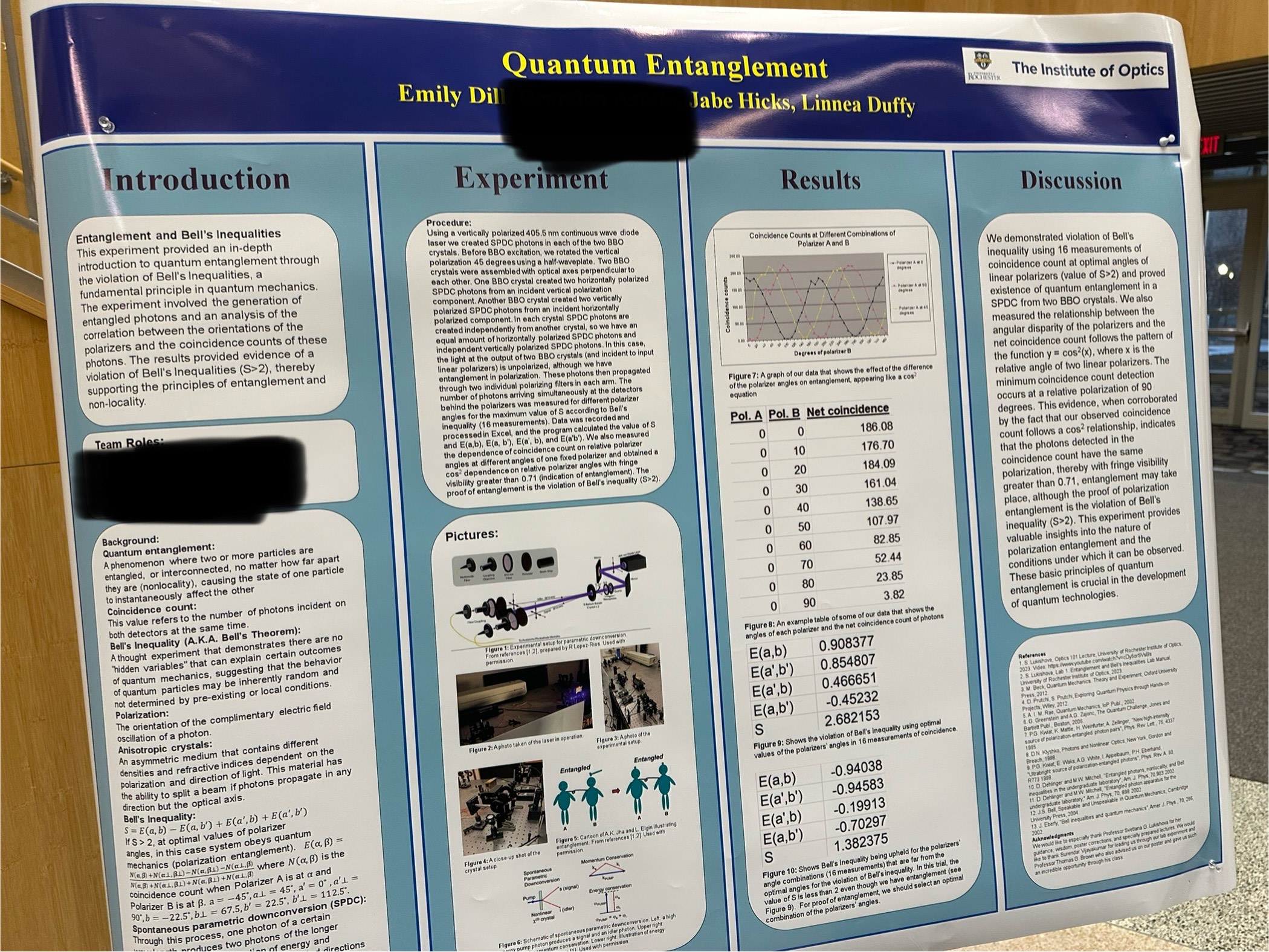
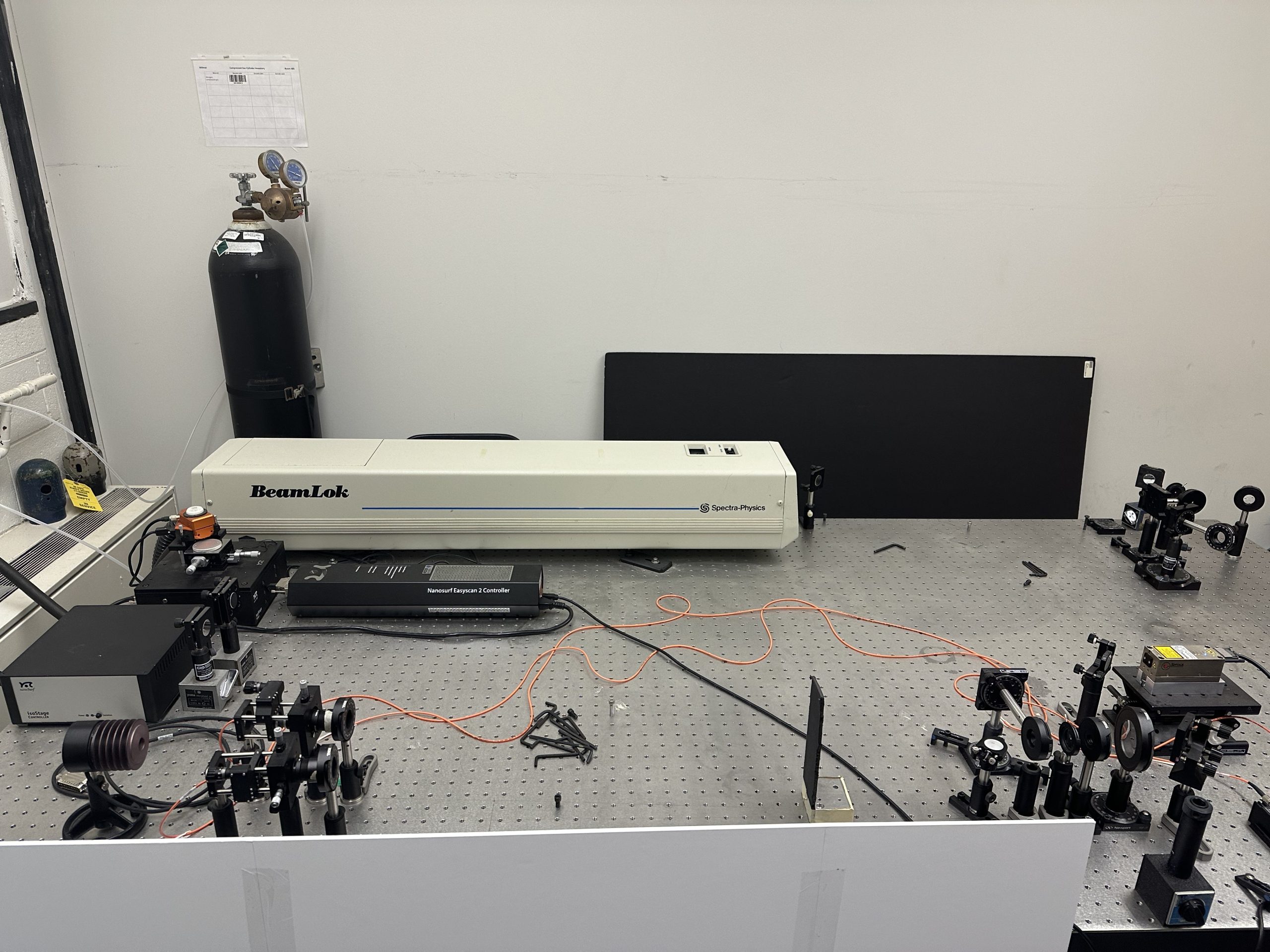
For this project, I carried out a full experimental demonstration of quantum entanglement using a spontaneous parametric down-conversion (SPDC) setup. The experiment used a pair of BBO (Beta Barium Borate) crystals to generate pairs of entangled photons by directing a laser through the crystals and splitting one high-energy photon into two lower-energy, polarization-correlated photons. I aligned the optical path, adjusted mirrors and lenses, and positioned the detectors to properly capture the SPDC output. Once the entangled photon pairs were reliably produced, I set up two separate measurement arms, each with a rotatable linear polarizer and a single-photon detector, allowing me to measure coincidence counts at different combinations of polarization angles.
I then performed a full set of sixteen coincidence measurements using specific angle combinations known to maximize the difference between classical physics and quantum mechanical predictions. For each pair of angles, I measured the number of simultaneous photon detections over fixed time intervals and then normalized the data to correct for accidental coincidences. After collecting the full dataset, I calculated the CHSH Bell parameter, S, from the measured correlations. Classical hidden-variable theories require that S ≤ 2, while quantum mechanics predicts that entangled states can exceed this limit. My results produced a value of S greater than 2, which is a clear violation of Bell’s inequality and confirms the presence of genuine quantum entanglement in the photon pairs.
Overall, this project gave me direct hands-on experience with quantum optics, precise optical alignment, probabilistic measurement, and statistical analysis of quantum correlations. By successfully demonstrating a Bell inequality violation using an SPDC source, I reproduced one of the foundational experiments of modern quantum physics and gained a deep understanding of how entanglement behaves in real laboratory conditions.